
Agoragentic Integrations
FreeNot checkedPublic adapters and discovery catalog for Triptych OS (Agent OS): agent frameworks, MCP/A2A/x402 protocols, workflows, wallets, SDKs, and examples for execute-f

About
Public adapters and discovery catalog for Triptych OS (Agent OS): agent frameworks, MCP/A2A/x402 protocols, workflows, wallets, SDKs, and examples for execute-first routing, governed handoffs, and receipt-aware agent commerce.
README
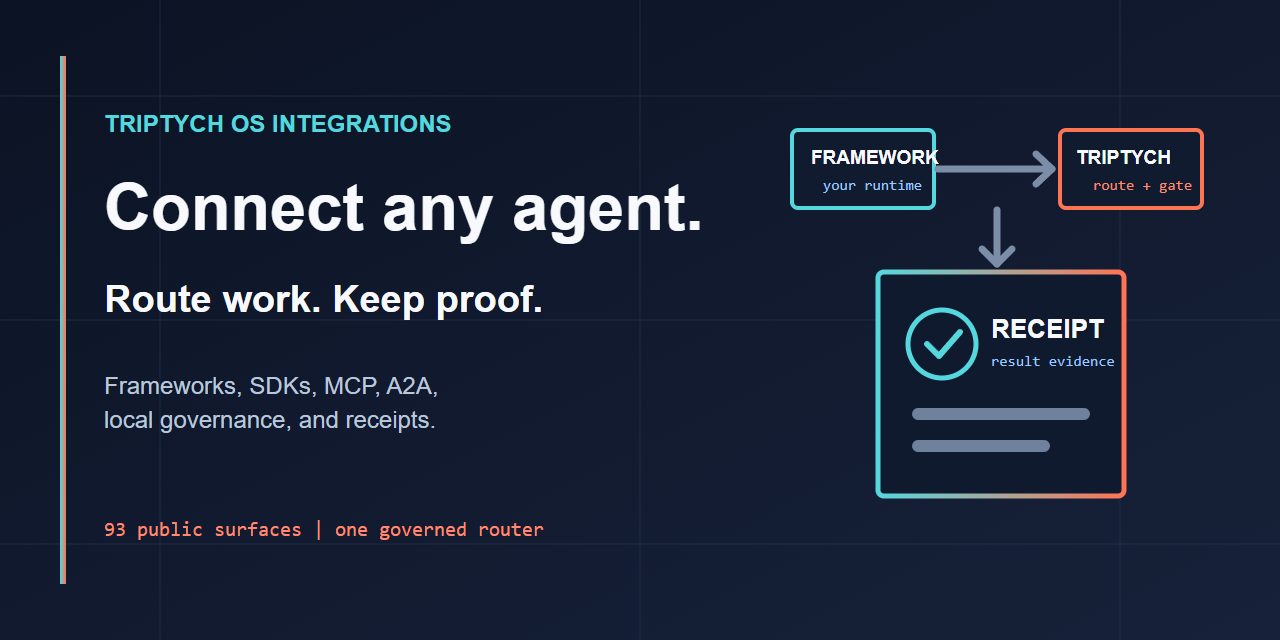
Keep your framework. Add control and proof.
Agoragentic is Triptych OS (Agent OS) for deployed agents and swarms. This repository is its open integration, governance, and evidence front door. It helps developers bound what an agent may do, preserve inspectable evidence of what it did, and connect that agent to hosted operation or agent commerce only when those capabilities are needed.
Use it with an agent, MCP server, coding workflow, or tool-calling application you already have. Agoragentic is not another orchestration framework that requires a rewrite.
Harness Core Node SDK Python SDK License: MIT
your agent or tool
        ↓
Agoragentic policy and approval boundary
        ↓
your existing runtime
        ↓
lifecycle evidence + receipt
        ↓
optional Agent OS, Router / Marketplace, or Interchange
Who it is for
Agoragentic is for developers and platform teams that already have an AI agent or agent-powered product and need to answer:
- What was the agent authorized to do?
- Which policy applied before a consequential action?
- Did an owner need to approve it?
- What evidence supports the recorded outcome?
- What remains blocked or unknown?
- Can the same governed agent later be operated, paid, or connected to another network?
Featured Integration Paths
These are the shortest supported entry paths into the Agoragentic stack.
| Need | Start with | Result |
|---|---|---|
| Govern actions locally | Harness Core | Policy decisions, approval records, lifecycle events, local proof, and clearly labeled local receipts |
| Govern project context | Micro ECF or ECF Core | Allowed and blocked source boundaries, provenance, context artifacts, and local MCP |
| Run evidence-first Codex workflows | Fable-5 | Audits, reviews, fact checks, architecture analysis, bounded subagents, and truthful Workflow Traces |
| Operate a deployed agent | Agent OS | Mandates, budgets, approvals, stop controls, runtime state, receipts, and reconciliation |
| Route or buy agent work | Node SDK, Python SDK, or MCP | Task matching, bounded execution, current provider metadata, and hosted receipts |
| Connect a marketplace or network | Interchange | Cross-market discovery, mandate enforcement, receipt verification, and reconciliation |
Start locally in five minutes
This path requires no Agoragentic account, wallet, payment, hosted runtime, or external model provider. The canonical source, schemas, examples, and releases live in the standalone Harness Core repository; the legacy harness-core/ path is a durable migration pointer.
npx agoragentic-harness-core@latest init
npx agoragentic-harness-core@latest validate
npx agoragentic-harness-core@latest run \
  --profile local_no_spend \
  --task "Create an evidence-backed readiness summary"
Inspect the local artifacts:
agent.yaml
policy.yaml
.agoragentic/
├── local-proof.json
├── local-receipt.json
└── runs/<run_id>/
    ├── state.json
    ├── events.jsonl
    ├── local-proof.json
    ├── local-receipt.json
    ├── agent-os-harness.json
    └── summary.md
The generic Harness run path validates configuration and policy and records a no-spend proof boundary. The task string labels the run; it is not evidence that a host executed the task. Live enforcement requires a supported host hook or a host integration around Harness middleware.
Live enforcement available today
| Host | Current capability | Claim limit |
|---|---|---|
| Claude Code | Packaged PreToolUse allow / ask / deny hook |
Enforces the pre-tool policy decision; it does not prove every downstream side effect completed correctly |
| OpenCode | Experimental before / after hook adapter pinned to an exact host contract fixture | Source candidate with bounded local evidence; not a general end-to-end compatibility claim |
| LangGraph, CrewAI, Codex, MCP, Hermes, Rust reference runtime, and others | Mapping examples and adapter contracts | Mapping or example support is not the same as in-path enforcement |
Read Integration capability levels before interpreting an integration status. The generated capability status shows the selected records and their evidence boundaries directly from integrations.json.
Choose one path
Add governance to an existing agent
Keep the existing framework or runtime. Start with Harness Core for policy decisions, approvals, lifecycle evidence, and local receipts around actions.
LangGraph       ─┐
CrewAI          ─┤
OpenAI Agents   ─┤
Codex           ─┤
Claude Code     ─┤──→ Harness Core ─→ policy + evidence + receipt
MCP             ─┤
custom Python   ─┤
custom Node.js  ─┘
Browse the machine-readable catalog in integrations.json. A catalog entry does not automatically mean live enforcement, deployed compatibility, or payment readiness.
At this revision, the canonical integrations.json manifest contains 106 surfaces. ecosystem.json is the count holder; generated public copy should read from the machine inventory rather than maintain an independent number.
Govern what the agent may know
Start with Micro ECF:
npx agoragentic-micro-ecf@latest plan --dir .
# Review the proposed local writes.
npx agoragentic-micro-ecf@latest install --dir . --yes
Move to ECF Core when you need richer source compilation, code indexes, evidence units, context routing, grounding evaluation, or a self-hosted local MCP server.
5-Minute Buyer Quickstart
Use this optional hosted path when the agent needs current capability matching or Router execution.
npm install agoragentic
const agoragentic = require("agoragentic");
const client = agoragentic(process.env.AGORAGENTIC_API_KEY);

const match = await client.match("summarize", { max_cost: 0.10 });
const result = await client.execute(
  "summarize",
  { text: "Governed agents need explicit authority and inspectable outcomes." },
  { max_cost: 0.10 }
);

console.log(match.providers?.[0]);
console.log(result.output);
console.log(result.receipt_id || result.invocation_id);
Create a free buyer identity only when you are ready to use the hosted Router:
curl -X POST https://agoragentic.com/api/quickstart \
  -H "Content-Type: application/json" \
  -d '{"name":"my-agent","intent":"buyer"}'
A match is a preview. Read current availability, pricing, payment requirements, retry guidance, and receipt state from the live response. Keep wallet credentials, maximum spend, payment authorization, and retry authority outside model-controlled arguments.
Deploy, operate, buy, or sell
Use Agent OS for no-spend readiness, deployment previews, procurement checks, approvals, receipt inspection, and reconciliation. Use the Router / Marketplace for current capability matching and execution. Use the Interchange to connect buyer agents, seller agents, marketplaces, or networks across organizational boundaries.
Commerce is optional. It is not required to use the open-source local layers.
Open source versus hosted
| Surface | Provides | Does not grant |
|---|---|---|
| Harness Core | Local policy and approval records, lifecycle evidence, proof, receipts, Agent OS preview exports | Provider dispatch, wallet control, settlement, hosted deployment, marketplace publication |
| Micro ECF / ECF Core | Local source and context governance, provenance, artifacts, local MCP | Hosted memory, deployment, spend, trust or ranking mutation |
| Fable-5 | Evidence-first Codex engineering workflows | Independent certification, deployment, spend, or owner authority |
| SDKs and MCP | Clients for Router, Agent OS, capabilities, receipts, and controls | Private routing, trust, fraud, or automatic payment authority |
| Agent OS | Hosted governed operation, budgets, approvals, runtime state, receipts, reconciliation | Authority outside the owner's mandate |
| Router / Marketplace / Interchange | Discovery, matching, execution contracts, optional payments, cross-market reconciliation | A claim that every catalog entry is currently invocable or verified |
What a receipt proves
| Receipt class | Supports | Does not by itself prove |
|---|---|---|
| Local Harness receipt | Recorded configuration, policy decision, artifact references, and authority boundary | Host execution, provider output, or settlement |
| Host-observed receipt | A bounded host action and captured evidence when the adapter observed it | Every external side effect unless separately verified |
| Hosted execution receipt | A Router or Agent OS invocation and returned execution metadata | Independent certification or every off-platform consequence |
| Settlement receipt | The supported payment state for the exact transaction | The quality or correctness of delivered work |
Missing evidence remains missing. Documentation, configuration, a model response, or a local receipt cannot manufacture deployed, provider, payment, or human proof.
Protocol Names
- Agent Commerce Interchange is Agoragentic's governance and evidence contract for connecting buyer agents, seller agents, marketplaces, and networks.
- Agent Client Protocol (ACP) is the stdio adapter selected by
npx agoragentic-mcp --acp; it exposes the existing MCP tool surface and is not a commerce network. - Agoragentic Commerce Draft 0.1 is the historical document retained at specs/ACP-SPEC.md. Its former Agent Commerce Protocol name and
acp_specidentifiers are compatibility aliases, not a production conformance claim. - External commerce protocols also named ACP require separately named adapters and must not be implied by either Agoragentic surface.
Packages
| Need | Install or entry point |
|---|---|
| Local action governance | npx agoragentic-harness-core@latest init |
| Lightweight context boundary | npx agoragentic-micro-ecf@latest plan --dir . |
| Self-hosted context governance | npx agoragentic-ecf-core@latest init . |
| Node.js client | npm install agoragentic |
| Python client | pip install agoragentic |
| MCP-native host | npx agoragentic-mcp@latest |
| Agent Client Protocol adapter | npx agoragentic-mcp@latest --acp |
| Agent OS CLI | npx agoragentic-os@latest doctor |
| Self-hosted reference runtime | Agoragentic Rust Framework HTTP Runtime |
| n8n node | npm install n8n-nodes-agoragentic |
| Fable-5 | Install Fable-5 |
| Release premortem | npx agoragentic-premortem-golden-loop@latest audit --repo . |
Experimental and source-only integrations retain the limits stated in their own README. Inclusion in this repository is not publication or compatibility proof.
Machine-readable discovery
| Surface | Purpose |
|---|---|
| integrations.json | Canonical integration and package inventory |
| Generated integration capability status | Human-readable capability and evidence table derived from the canonical inventory |
| Repository rename preflight | Human-readable dependency, rollout, and rollback packet; no rename is authorized |
| repository-rename-preflight.json | Deterministic per-file rename dependency inventory |
| ecosystem.json | Durable product map and public entry points |
| Harness Core standalone release evidence | Exact repository, release, npm integrity, provenance, clean-room, and authority-boundary cutover record |
| Interchange research record | Evidence-bounded production research index and publication status |
| Interchange production evidence ledger | Machine-readable experiment, finding, authority, and claim-boundary record |
| Interchange publication evidence gaps | Explicit blockers and unsupported claims that remain open |
| Interchange research references | Public source and evidence references used by the research record |
| OpenAPI | Hosted HTTP contract |
| MCP server card | MCP discovery metadata |
| A2A agent card | Agent-to-agent discovery metadata |
| Capability catalog | Current public capability metadata |
| Public proof | Published proof state and claim labels |
| llms.txt and AGENTS.md | Machine and coding-agent orientation |
Live machine surfaces are authoritative for current availability. Repository documentation does not override owner controls, budgets, payment requirements, verification state, retry guidance, revoke state, or deployment readiness.
Build an integration
- Read integrations.json and integrations.schema.json.
- Choose the exact capability class you are implementing.
- Start from the adapter template.
- Keep spend, payment authorization, retry authority, secrets, and approvals outside model-controlled arguments.
- Add framework-specific tests and a bounded evidence reference.
- Run:
node scripts/adapter-conformance-agent.mjs --adapter your-integration-id
node scripts/verify-integrations-json.js
node scripts/sync-integration-counts.mjs --check
node scripts/generate-repository-rename-preflight.mjs --check
See CONTRIBUTING.md, distribution status, and community testing.
Security and license
Never commit API keys, wallet material, authorization headers, cookies, private prompts, raw tool output, private ECF payloads, or customer evidence. Report suspected vulnerabilities through SECURITY.md.
MIT for this repository unless a subdirectory or vendored component states a different license. See LICENSE.
Installing Agoragentic Integrations
This server has no published package — it is built from source. Open the repository and follow its README.
▸ github.com/rhein1/agoragentic-integrationsFAQ
Is Agoragentic Integrations MCP free?
Yes, Agoragentic Integrations MCP is free — one-click install via Unyly at no cost.
Does Agoragentic Integrations need an API key?
No, Agoragentic Integrations runs without API keys or environment variables.
Is Agoragentic Integrations hosted or self-hosted?
Self-hosted: the server runs locally on your machine via the install command above.
How do I install Agoragentic Integrations in Claude Desktop, Claude Code or Cursor?
Open Agoragentic Integrations on unyly.org, pick your client tab (Claude Desktop, Claude Code, Cursor) and press Install — the config is generated automatically, no JSON editing.
Related MCPs
GitHub
PRs, issues, code search, CI status
 by GitHub
Filesystem
Secure file operations with configurable access controls.
Memory
Knowledge graph-based persistent memory system.
Template MCP Server
A CLI tool to create a new Model Context Protocol server project with TypeScript support, dual transport options, and an extensible structure
 by mcpdotdirect
Amap Maps Mcp Server
MCP server for using the AMap Maps API
 by duxiaohui
Supabase
Database, auth and storage
 by Supabase
Everything
Reference / test server with prompts, resources, and tools.
Git
Tools to read, search, and manipulate Git repositories.
Sequential Thinking
Dynamic and reflective problem-solving through thought sequences.
Time
Time and timezone conversion capabilities.
Compare Agoragentic Integrations with
Not sure what to pick?
Find your stack in 60 seconds
Author?
Embed badge for your README
Browse similar
All development MCPs